Been Out of the Workforce for Years?
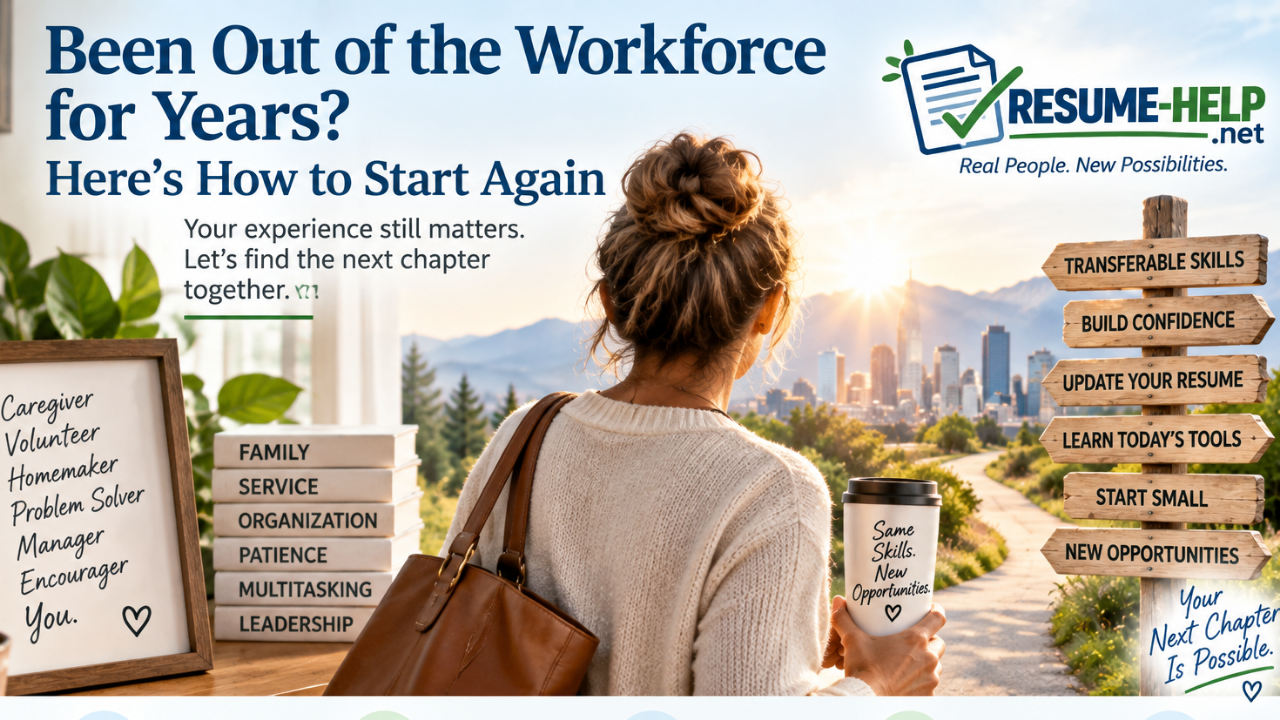
Here’s How to Start Again
Being out of the workforce for several years can make returning feel intimidating. Maybe you stayed home to raise children. Maybe you cared for a parent, spouse or another family member. Perhaps you retired and now want or need to work again. Maybe illness, family circumstances, military moves, education or simply life took you away from paid employment for a while.
Whatever the reason, one of the easiest mistakes to make is looking at those years and thinking, I have nothing to put on a résumé anymore.
Before you decide that, take a closer look.
This doesn't mean turning grocery shopping into “supply-chain management” or calling yourself the “CEO of the household.” Employers can see through inflated language, and you shouldn't have to exaggerate your life to make it valuable. What it does mean is examining what you actually did during those years, what you knew how to do before your career pause, what you've learned since, and which parts of that experience may legitimately matter to an employer now.
You may have more to work with than you think.
Start With What You Did Before the Gap
If you worked before leaving the workforce, that experience didn't disappear simply because time passed. You may need to update certain technical skills or learn newer systems, but years away from paid employment don't erase your previous knowledge, accomplishments or abilities.
Start by reconstructing your earlier work history. Don't rely only on old job titles. Think about what you actually did. Did you supervise people, work with customers, manage schedules, handle money, solve problems, train employees, maintain records, organize projects, work with vendors or use specialized equipment? Did you receive promotions, improve something, take on responsibilities beyond your original position or become the person others relied on for certain problems?
Those details can still be relevant. Your first task isn't to decide whether an employer will care about every one of them. It's to remember what was there.
Look Honestly at What Happened During the Years You Weren't Employed
Now examine the gap itself.
Some people truly won't have much from those years that belongs on a professional résumé, and that's okay. You don't have to manufacture experience to fill empty space.
But other people have spent those years doing things that may legitimately matter. Perhaps you volunteered regularly, served in a leadership position, kept financial records for an organization, coordinated large events, managed a family business, performed freelance work, completed significant community or church responsibilities, cared for someone with complicated needs, earned certifications, took classes or learned technology.
The important question isn't, “How can I make everything I did sound like a job?” It's, “Did I do anything during this time that provides genuine evidence of a skill or experience relevant to the work I want now?”
That's a very different question—and a much more useful one.
Don't Automatically Dismiss Unpaid Experience
People have an odd habit of assuming that if nobody handed them a paycheck, nothing they did counts.
Employers aren't hiring your paycheck history. They're hiring someone who can do something they need done.
Suppose you volunteered for several years and genuinely coordinated 40 volunteers, created schedules and organized community events. That's real experience. If you maintained bookkeeping records for a nonprofit, that's real experience. If you helped run a family business without formally being on payroll, there may be legitimate business experience worth discussing.
On the other hand, simply managing your own household doesn't automatically make you a professional project manager, accountant or operations director. The goal is to identify real evidence, not invent impressive titles for ordinary responsibilities.
That distinction is important throughout Resume-Help: your experience doesn't need exaggeration to have value.
Deal With the Résumé Gap Without Apologizing for Your Life
A long employment gap can feel enormous to you because you know exactly how many months or years it represents. That doesn't mean your entire résumé needs to revolve around explaining it.
Your résumé's primary purpose is to show an employer why your background may be useful for the position you're pursuing now.
Depending on your circumstances, relevant volunteer work, education, freelance work or other substantial activities during the gap may naturally appear on the résumé. In other situations, there may simply be a gap between positions. If an employer asks about it, you can explain it truthfully and briefly.
You don't need a long apology.
“I stepped away from the workforce to care for my family, and I'm now ready to return” can be enough. Then the conversation can move to the more important question: What can you do for this employer today?
Find Out What Has Changed Since You Last Worked
This is one area where returning workers need to be realistic. Depending on how long you've been away, the workplace may have changed.
Software has changed. Hiring has changed. Communication tools have changed. Entire industries have changed. Artificial intelligence is now part of many workplaces, and tools that were common ten years ago may have been replaced by completely different systems.
You don't have to become an expert in everything before applying for a job. You do need to find out what's commonly expected in the work you want to pursue.
Look at current job postings. Notice which programs, platforms, certifications and technical skills appear repeatedly. Then determine which ones you already know, which ones you could refresh quickly and which ones you genuinely need to learn.
Sometimes a short class, online tutorial or a few weeks of deliberate practice can close a technology gap that initially looked much bigger.
Don't Assume You Have to Go Back to What You Did Before
Returning to work doesn't necessarily mean returning to the exact occupation you left.
Your circumstances may be different now. Perhaps you no longer want the hours, physical demands, travel or stress of your previous career. Maybe you want part-time work. Maybe you need better benefits. Perhaps you're interested in an entirely different field.
That's where transferable skills become especially important.
Someone who spent years in hospitality, for example, may have experience in customer service, operations, scheduling, training, sales, conflict resolution and team leadership. Someone who worked in an office may have organizational, administrative, technology and communication skills useful in many different environments.
If you're unsure where your background could take you now, the Career Direction Assessment on Resume-Help can help you explore several possibilities instead of forcing you toward one predetermined career.
Build the Résumé From What Is True Now
Once you've examined your previous employment, your years away and what you want to do next, you're in a much better position to create a résumé.
This is where many returning workers get stuck because they're trying to write and evaluate themselves at the same time. They remember an old job, immediately decide it isn't relevant anymore, and leave it out. They remember volunteer experience and decide it “doesn't count.” They overlook accomplishments because those accomplishments happened years ago.
Instead, start by gathering the information before deciding what belongs in the final résumé.
The Build My Base Résumé tool on Resume-Help is designed to interview you one question at a time and help uncover relevant experience you might otherwise overlook. If you already have an old résumé, the Make My Résumé Stronger tool can help you examine what's missing and rebuild it into a stronger current document.
And if you're sitting there thinking, But I really don't have anything worth putting on a résumé, start with our free But I Don't Have Anything Worth Putting on a Résumé guide. That's exactly who we created it for.
Be Willing to Start Somewhere Realistic
Returning to work after a long absence may require some flexibility. Your first job back doesn't necessarily have to be your perfect long-term position.
A part-time job might give you recent experience and references. A position slightly below the level you once held might help you update your skills and move up quickly. Temporary or contract work may provide a way into an industry. A job that isn't perfect may introduce you to people, technology and opportunities you couldn't reach from outside the workforce.
At the same time, don't automatically assume you have to start at the very bottom simply because you've been away. Your previous experience still exists. The right starting point depends on what you've done, what has changed, what you can currently do and what the employer needs.
The goal isn't to start over as though everything before today has been erased. It's to find the most realistic place to start again.
Your Next Chapter Doesn't Have to Look Like Your Last One
A career pause is part of your story. It doesn't have to be the end of it.
You may need to update some skills. You may discover that the job market uses different terminology now. You may need practice talking about your experience again. You may even decide that the work you want today is completely different from the work you wanted years ago.
That's all right.
Start with the truth about what you've done. Identify what still transfers. Learn what needs updating. Explore what fits your life now. Then take one realistic step forward.
You aren't trying to recreate the person you were before you left the workforce. You're figuring out what the person you are today can do next.
