How to Start Looking for a Job When You Don’t Know Where to Begin
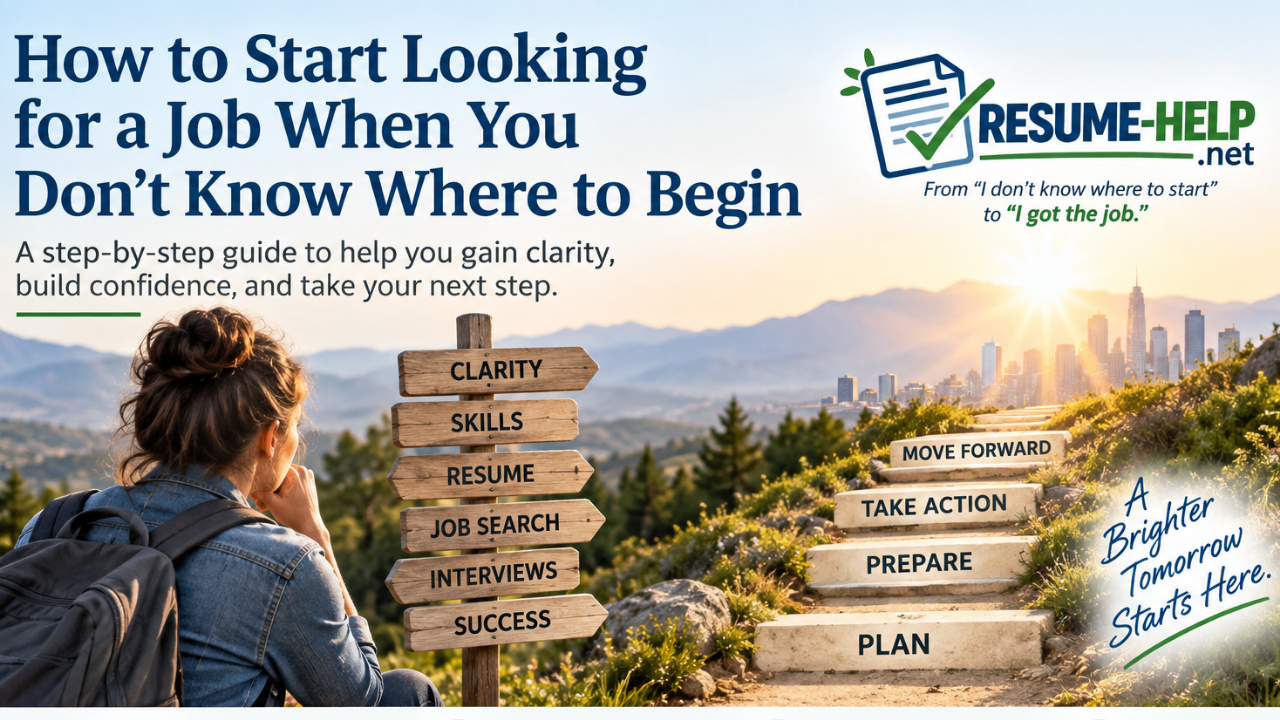
Looking for a job can feel like a job all by itself. In fact, it can feel like the hardest job in the world.
Maybe you know you need to find work, but you aren't sure what kind of work you want. Maybe you haven't written a résumé in years. Maybe you've never written one at all. Maybe you've been applying for jobs and hearing nothing back. Or perhaps you've opened a job-search website, looked at hundreds of listings, and thought, I don't even know what I should be searching for.
You don't need to solve everything today.
A successful job search is really a series of smaller steps. When you take them in the right order, something that initially feels overwhelming becomes much more manageable.
Here is a good place to begin.
Step 1: Figure Out Where You Might Be Going
It's difficult to search for a job when you don't know what you're searching for.
You don't necessarily need to choose your forever career. You simply need enough direction to identify some realistic possibilities.
Start by thinking beyond job titles. What kinds of activities do you enjoy? Do you like helping people, organizing things, solving problems, working with your hands, analyzing information, creating things, leading others, working independently, or being part of a team?
Also think about what you need from work. Schedule, income, location, physical demands, flexibility, education requirements and opportunities for advancement can matter just as much as the work itself.
If you're drawing a complete blank, that's exactly why we created the Career Direction Assessment on Resume-Help.net. It can help you explore career families and possible job directions based on your interests and preferences.
You don't have to know exactly where you're going before you take the first step. You just need some promising directions to explore.
Step 2: Stop Underestimating What You Already Know How to Do
Before you decide that you aren't qualified for anything, take inventory.
Work experience obviously counts, but experience doesn't come exclusively from traditional employment. Military service, volunteer work, caregiving, community involvement, school projects, freelance work, family businesses and other responsibilities may also provide relevant experience.
The key is not to exaggerate ordinary life into professional experience. It's to look carefully at what you have actually done.
Have you trained people? Managed money? Resolved customer problems? Coordinated schedules? Used specialized equipment or software? Organized events? Increased sales? Reduced costs? Worked under pressure? Supervised employees? Managed projects? Maintained records? Solved complicated problems?
Those details matter.
Sometimes people have much more experience than they realize because they've become so accustomed to doing something that it no longer seems remarkable to them.
Resume-Help's Build My Base Résumé tool is designed to help uncover that information before writing the résumé.
Step 3: Build a Base Résumé Before You Start Applying Everywhere
Your base résumé is your starting document.
It doesn't have to be limited to one page, and it doesn't have to be perfectly targeted to a particular employer yet. Its job is to capture the strongest truthful picture of your work history, skills, accomplishments, education, training and relevant experience.
Think of it as your résumé inventory.
Later, when you find a specific opportunity, you can select and emphasize the information that matters most for that particular job.
If you already have a résumé but it feels weak, outdated or generic, you don't necessarily need to throw away your experience. You may simply need to uncover what's missing and tell the story more effectively. That's what the Make My Résumé Stronger tool is designed to help you do.
Step 4: Learn Which Job Titles Actually Match Your Experience
Here's a surprisingly common job-search problem: people search only for titles they've held before.
That can dramatically limit the opportunities they see.
The same skills may appear under very different job titles from one employer or industry to another. Someone with restaurant management experience, for example, may have skills relevant to operations, customer service, training, scheduling, recruiting, safety, inventory, team leadership or other areas.
Instead of asking only, “What job have I done before?” ask:
“What jobs use the things I already know how to do?”
Resume-Help's Find My Best Job Titles tool can help identify realistic job-title families and search terms based on your actual experience.
Those additional search terms can open doors you may never have thought to look behind.
Step 5: Search Smarter, Not Just Longer
Once you know what you're looking for, job searching becomes much more productive.
Use several sources rather than depending on one giant job board. Search employer career pages, government employment sites, specialized job boards, staffing agencies, professional organizations and local resources.
Resume-Help includes a Job Search Websites resource with places you can search on your own, as well as a Find Current Jobs Near Me tool that can help locate current openings based on your job interests, location, travel distance, pay needs and other preferences.
Utah job seekers can also use our Find Utah Job Fairs tool to look for verified upcoming career fairs and hiring events.
But don't apply to everything simply because you can.
Ten thoughtful applications for jobs that make sense may be far more useful than sending the exact same résumé to dozens of unrelated employers.
Step 6: Tailor Your Résumé to the Job
Your base résumé tells your whole professional story.
The résumé you submit to an employer should tell the part of that story that matters most to that employer.
Read the job description carefully. Which responsibilities appear most important? Which qualifications do you genuinely have? Which accomplishments from your background demonstrate that you can do what this employer needs?
Then make those things easy to find.
This does not mean copying keywords into your résumé whether they belong there or not. And it certainly doesn't mean inventing qualifications to get through an applicant tracking system.
It means presenting your real qualifications in the language most relevant to the opportunity.
The Tailor My Résumé & Cover Letter tool on Resume-Help can help you rebuild your résumé around a specific job posting while keeping everything truthful.
Step 7: Prepare for the Interview Before You Get the Interview
Don't wait until 9:00 the night before an interview to start figuring out what you're going to say.
Think about examples from your experience that demonstrate how you work.
When did you solve a problem? Help a difficult customer? Learn something quickly? Handle competing priorities? Make a mistake and correct it? Help a team succeed? Take initiative? Improve something?
Specific examples are much more convincing than simply telling an interviewer, “I'm a hard worker.”
You don't need to memorize speeches. You need to become comfortable talking about your own experience clearly and naturally.
Our Practice Interview tool can conduct a realistic interview based on the actual position you're pursuing, one question at a time, and help you strengthen answers that need more detail.
Step 8: Follow Up Like a Real Person
After an interview, send a thoughtful thank-you.
It doesn't need to be long. Thank the interviewer for the conversation, mention something specific you discussed when appropriate, and reaffirm your interest if you're genuinely interested.
A personal follow-up can also remind the employer of something important about you after they've spent the day meeting several candidates.
Resume-Help's Follow Up & Stand Out tool can help you create a concise, personalized message without making it sound like a generic form letter.
You Don't Have to Do Everything Today
This may be the most important part.
You don't have to choose a career, create a résumé, find 20 jobs, write five cover letters, master interviewing and reinvent your entire life before dinner.
Pick one next step.
If you don't know what kind of work you want, start with career direction.
If you know what you want but don't have a résumé, build your base résumé.
If you already have one, strengthen it.
If your résumé is ready, start looking for realistic opportunities.
If you've found a job you want, tailor your application.
If you've landed an interview, practice.
Then take the next step after that.
A job search becomes much less frightening when you stop treating it as one enormous problem and start treating it as a path made up of individual decisions.
You don't have to see the entire path to begin. You just need to know your next step.
And that's exactly what Resume-Help.net was built to help you find.
